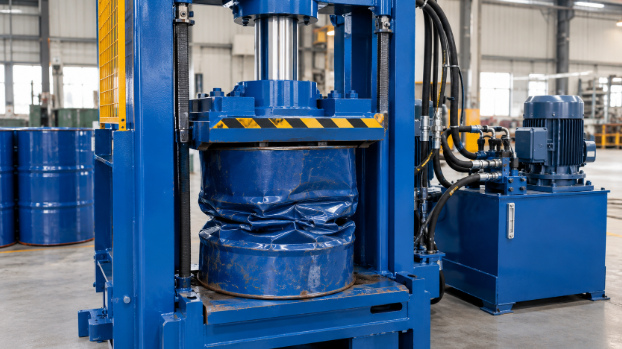
Empty 55-gallon drums pile up fast in manufacturing plants, warehouses, and recycling centers. They take up floor space, cost money to transport, and become a real headache when dozens or hundreds accumulate at once. Many businesses eventually look for a better way to manage this waste stream. That's where a 55 gallon drum crusher comes in.
By flattening empty steel or metal drums into compact discs, this equipment turns a bulky storage problem into something manageable. Companies like Fabtex Sustatech design industrial equipment aimed at exactly this kind of waste-handling challenge, including our hydraulic drum crusher range.
What Is a 55 Gallon Drum Crusher?
A 55-gallon drum is a standard cylindrical container used across industries to store liquids, chemicals, oils, paints, and other materials. Once emptied, these drums don't disappear — they still need to be stored, moved, or recycled, and their round shape wastes a lot of space when stacked.
A 55 gallon drum crusher is a piece of industrial equipment built to solve that problem. It applies strong downward force to an empty drum, flattening it into a compact disc-shaped piece of scrap metal. This is different from ordinary drum handling, where drums are simply stacked, stored, or hauled away in their original shape. Crushing physically reduces the drum's volume, which changes how much space it takes up and how efficiently it can be transported for recycling.
How Does a 55 Gallon Drum Crusher Work?
The general process behind a hydraulic drum crusher is straightforward, even though the engineering behind it is fairly sophisticated:
- Drum positioning – The empty drum is placed inside the crushing chamber of the machine.
- Machine activation – The operator starts the crushing cycle using the machine's controls.
- Hydraulic compression – A hydraulic ram, powered by pressurized hydraulic fluid, moves downward with significant crushing force.
- Drum compression – The drum is compressed steadily until it reaches a flattened state.
- Removal and storage – The crushed drum is removed from the chamber and moved to a storage or recycling area.
This cycle repeats for each drum, and the entire process is designed to be controlled and repeatable rather than relying on manual force.
Why Use a 55 Gallon Drum Crusher?
The core benefit of drum crushing is volume reduction. A flattened drum takes up a fraction of the space an intact one does, which has several practical effects on daily operations:
- Less warehouse or yard space is tied up storing empty containers.
- Fewer trips are needed to transport the same number of drums.
- Recycling and scrap metal handling becomes more organized.
- Waste-management workflows move more efficiently because drums aren't piling up in walkways or storage bays.
These are practical, day-to-day improvements rather than guaranteed outcomes — the actual impact depends on drum volume, crushing frequency, and how a facility is laid out.
Applications of Industrial Drum Crushers
Drum crushers are used in a range of industrial settings where empty containers are a regular part of operations:
- Manufacturing facilities that go through drums of raw materials or chemicals.
- Recycling operations handling scrap metal from steel and metal barrels.
- Industrial waste management sites processing containers from multiple sources.
- Warehouses and logistics centers storing drums before disposal or resale.
- Processing facilities in oil, paint, and chemical industries.
- Commercial operations that regularly generate large volumes of empty drums.
Crushed drums are often handled together with other metal scrap. Facilities that also need to compress loose metal waste may look at a continuous scrap baler, while operations that need to reduce bulky material before baling can consider a double shaft shredder.
Factors to Consider When Choosing a 55 Gallon Drum Crusher
Selecting the right equipment means looking past the basic function and thinking about how it fits your operation:
- Drum dimensions — confirm the machine's chamber accommodates standard 55-gallon drum sizes.
- Drum material — steel, mild steel, and other metal drums each interact differently with crushing force.
- Crushing mechanism and hydraulic system — understand how the hydraulic pressure is generated and controlled.
- Crushing capacity — match the machine's rated capacity to your expected volume.
- Machine construction — heavy-duty construction affects long-term durability.
- Safety features — look for overload protection, emergency stop functions, and secure enclosures.
- Operating environment — indoor vs. outdoor use can affect equipment choice.
- Maintenance requirements — ask about servicing needs and expected upkeep.
- Available floor space — measure your facility before committing to a footprint.
- Throughput requirements — how many drums need processing per day or week.
- Manufacturer support — installation guidance and after-sales assistance matter over the equipment's lifespan.
If you are still deciding which type of equipment suits your facility, our article on choosing the right recycling machine covers waste type, volume, space, and support in more detail.
55 Gallon Drum Crusher vs. Manual Drum Handling
Manually flattening or handling empty drums can work for very low volumes, but it comes with trade-offs. It's labor-intensive, slower, and can introduce safety risks when workers try to compress metal containers without proper equipment. A mechanical drum crusher offers more consistency and reduces physical strain on staff.
That said, manual handling isn't always the wrong choice. For facilities generating only a handful of empty drums occasionally, investing in a dedicated crusher may not be necessary. The right approach depends on drum volume, available budget, and how central waste handling is to daily operations.
Why Choose Fabtex Sustatech?
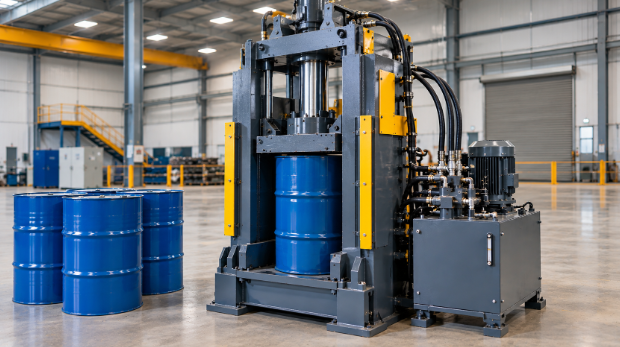
Fabtex Sustatech is a Georgia-based manufacturer of industrial balers, shredders, and drum crushing equipment built for manufacturing plants, recycling facilities, and waste-management operations. Their hydraulic drum crusher systems are engineered to compact steel drums, oil drums, and paint drums, with attention to structural durability and operational safety.
For businesses evaluating drum crushing equipment as part of a broader waste-reduction strategy, Fabtex Sustatech's industrial background in recycling machinery makes them a relevant option to explore. Learn more about Fabtex Sustatech and our manufacturing experience.
Conclusion
A 55 gallon drum crusher addresses a very specific but common industrial problem: what to do with empty drums once they've served their purpose. By reducing drum volume through hydraulic compression, this equipment helps facilities save storage space and streamline waste handling. Choosing the right machine comes down to matching drum size, crushing capacity, safety features, and available space to your actual operational needs.
Fabtex Sustatech's background in industrial recycling machinery makes them a reasonable starting point for businesses researching this type of equipment.
Ready to Explore Drum Crushing Solutions?
Contact Fabtex Sustatech to discuss your drum crushing or industrial waste-handling requirements.
Get in Touch →